
2P comparison of JEDI2Psub and JEDI3 sensors
In vitro characterization at 23C
All data in this section: JEDI-2P and JEDI-2Psub were collected on the same days and are the same data as in the publication. JEDI3hyp and JEDI3sub were collected on different days from the JEDI-2Psub and are the same data as in the publication.
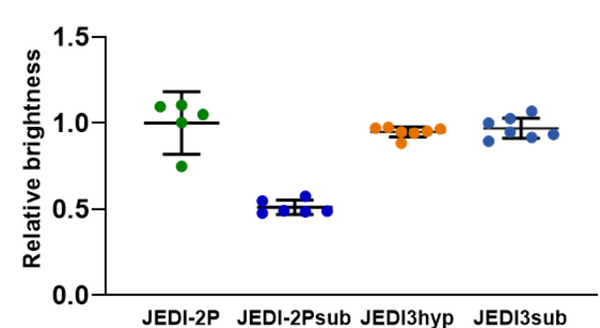
Brightness at -83 mV
Photostability

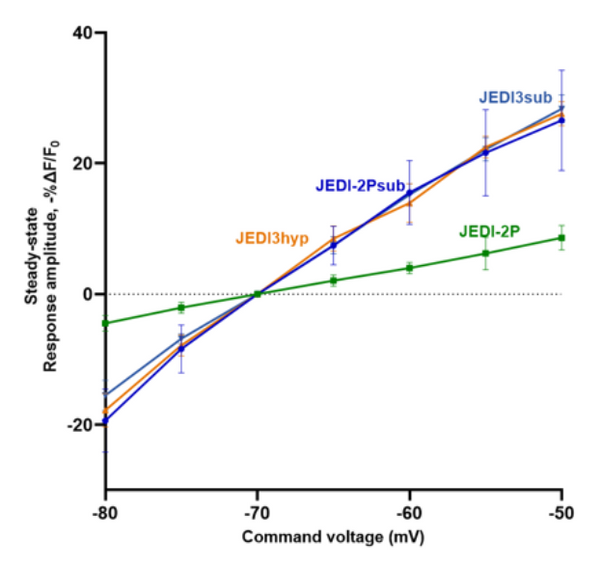
Fluorescence vs. voltage:

Response to a spike waveform:

100Hz spike train:

Spike-on-subthreshold waveform:

Spike-on-subthreshold waveform:

1P Kinetics done at 33C

Values are the time constants of the optical response to voltage steps, expressed as means ± 95% confidence interval (CI). HEK293A cells were used.
Which sensor to choose:
JEDI3hyp and JEDI3sub indicators exhibit comparable overall performance. However, we recommend JEDI3sub over JEDI3hyp for most applications where subthreshold detection is a goal, due to its slightly higher brightness and enhanced spike-detection capabilities in certain comparisons. JEDI3hyp demonstrates larger responses to voltage steps below –80 mV (from a holding potential of –70 mV), particularly at elevated temperatures (≥33 °C). This property may make JEDI3hyp particularly useful for investigating voltage dynamics in astrocytes, mitochondria and plants—all of which can exhibit resting membrane potentials below –80 mV.
JEDI-2Psub has a very similar dynamic range to JEDI3hyp; however, it's half as bright at resting membrane potentials. JEDI-2Psub also has slower depolarization and repolarization kinetics (see kinetics table and the 100Hz waveform), making this sensor less desirable for faster voltage transients. Overall, we recommend JEDI3hyp over JEDI-2Psub for most applications.
For action potential detection only, when you want a bright-to-dim sensor, we still recommend JEDI-2P. JEDI-2P is faster at suprathreshold voltages and has a greater dynamic range beyond -45 mV when compared to the other three sensors.
Publications:
Carolan, J., Land, M. A., Lu, X., Beau, M., Kostadinov, D., St-Pierre, F., ... & Häusser, M. (2025). All-optical voltage interrogation for probing synaptic plasticity in vivo. Nature Communications, 16(1), 8834.
Land, M. A., Galdamez, M., Villette, V., Zhu, J., Lu, X., Marosi, M., ... & St-Pierre, F. (2026). Designer indicators for two-photon recording of subthreshold voltage dynamics. Nature Methods, 1-12.
JEDI-2Psub Addgene numbers
We no longer support shipping out JEDI-2Psub AAVs or plasmids, people interested should buy them from Addgene and package themselves